
How I can help...
I know exactly what it’s like to fight your own brain just to get through a Tuesday because I've lived it. I’ve lived through the 'all-or-nothing' energy cycles — the days where hyperfocus makes you feel invincible, followed by the days where opening an email feels like climbing a mountain.
You aren't lazy and you don't lack discipline
You just have a nervous system that navigates and processes the world at a different frequency. You're white-knuckling your way through a career that should feel fulfilling, but it's sucking the life out of you. But I'm not just going to give you a "to-do" list and a bunch of handouts. We’re going to dig in to how your unique brain actually operates. We’ll use curiosity instead of judgment to find the friction points in your day and build a life that feels more "you".
Stop letting (other people's) labels define you.
Let's go beneath the surface and understand your real struggles and strengths.
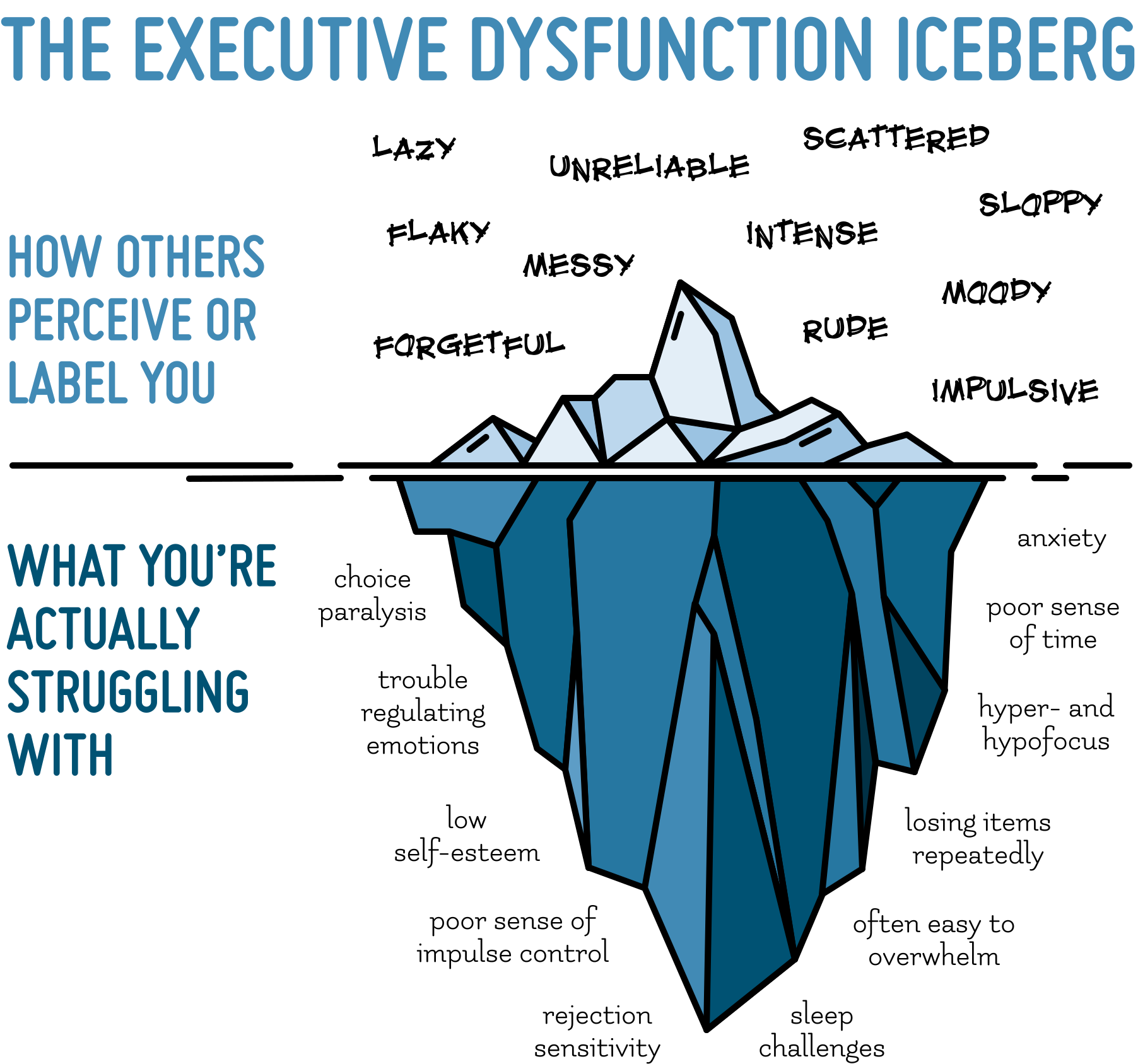
ADHD or no, everyone can benefit from a better understanding of their own Executive Functioning skills and how to improve them.
The modern world asks our brains to do a tremendous amount of invisible, exhausting heavy lifting every day. Strengthening your executive functioning isn't about forcing yourself to become a perfectly optimized, hyper-productive robot; it’s about giving yourself the grace to figure out how you actually handle overwhelm, start difficult tasks, and follow through.
When we strip away the heavy shame of thinking, "I should just be able to do this," we can build self-compassionate strategies that create true breathing room in our lives.
My goal is to help you stop fighting your own nature and start building a life that finally feels sustainable and rewarding.
To help you start exploring how your beautifully wired brain operates, I've provided a summary of Executive Functioning skills here.
FOUNDATIONAL: Core cognitive processes that form the building blocks for higher-order EF skills
EMOTIONAL CONTROL
Staying calm and grounded in order to achieve goals, direct behavior, or navigate stressful situations
SELF-AWARENESS
Objectively “viewing” oneself and candidly recognizing one’s strengths and struggles
COGNITIVE FLEXIBILITY
Adapting thoughts and actions in response to changing situations and new perspectives
SUSTAINED FOCUS
This is the capacity to maintain your attention to a situation or task in spite of distractions, fatigue, or boredom
WORKING MEMORY
Holding, using and recalling information in one’s mind in real-time while performing tasks
IMPULSE CONTROL
Managing impulses and the capacity to think before acting
STRUCTURAL
GOAL PLANNING
Defining objectives and outlining steps and strategies to achieve them
PRIORITIZING
Determining the empirical and relative importance of tasks and activities
ORGANIZATION
Structuring and tracking various resources, tasks & thoughts systematically using methods that align with one’s brain
TIME MANAGEMENT
Estimating and using time effectively to balance competing priorities and complete tasks within any time limits or deadlines
DYNAMIC
TASK INITIATION
Starting tasks purposefully and promptly, even when it seems overwhelming, boring, or unimportant
DIRECTED PERSISTENCE
Focusing and following through on one’s objectives in the face of distractions, fatigue, or boredom
COGNITIVE SHIFTING
Transitioning smoothly between tasks or thought processes
SELF-MONITORING
Reflecting on one’s progress and adapting strategies as needed
Phase 2: Mastering time and tasks
Time can feel like a blur when you’re busy. This phase is about taking those invisible thoughts and time-slips and making them "physical" so you can manage them.
WEEK 3: getting grounded in time
We’ll explore why time feels "slippery" for you. We’ll experiment with tools that show you time disappearing (like a visual countdown) so it stops being an abstract concept.
I'll help you conduct a time audit; we’ll spend 72 hours just noticing where the hours go without trying to fix anything. We're looking for the "time leaks."
We'll experiment with overestimating task durations to include buffer time, and experiment with tactics like the
Short Burst method; commit to a task for just 5 minutes & when the timer goes off, you have total permission to stop... if you
want
to.
WEEK 4: CLEARING THE MENTAL WORKBENCH
Your brain is tired because it's trying to remember 100 things at once. We’re going to move those things to a "safe place" so your mind can finally relax.
I’ll guide you through a session where we do a brain dump: externalizing everything on your mind and assign one of the four "D"s to them — Do, Defer, Delegate, Don't — to reduce time anxiety and free up your working memory.
We’ll also take a project you’ve been avoiding and find the Atomic Start. For example, if the task is "write the report," the atomic start might be "open a blank Word document."
Phase 3: Designing your environment
Your surroundings are either helping you or hindering you. We’re going to "re-engineer" your physical space and your digital world to support your focus.
WEEK 5: your digital home base
We’ll find one (and only one) tool that feels intuitive to you — whether it’s a digital app or a physical planner — to act as your "Second Brain."
You'll set up a Capture Zone. This is a single place where you put every idea, link, or task so (a) it doesn't get lost in your email or on random sticky notes, and (b) you can return to it at a later time.
We’ll experiment with
tools and tactics to find the one that adapts to your brain (not the other way around) that helps you focus on just what's important today (not the entire mountain).
WEEK 5: THE GOLDILOCKS FOCUS TEST
We’re going to find the environment that is "just right" for your brain. Some people need total silence; others need the hum of a fan, the thrum of EDM, or the background noise of a cafe.
We’ll run
Focus Experiments. One day you'll work with music, one day in silence, one day with a "body double" (someone else working nearby). We’ll see which one yields the best results.
We'll clear the cobwebs; identifying "hot spots" in your office where clutter piles up, and experimenting with a two-minute "reset ritual" for that space.
Phase 4: Navigating the emotional side of work
Executive functioning isn't just about calendars; it's about how you feel. We’ll look at the "Wall of Awful" and how to climb over it when you're feeling overwhelmed or criticized.
WEEK 7: THE ART OF THE START
When you feel "paralyzed" by a goal or task, it’s usually because your brain’s alarm system is going off. We’ll learn how to quiet that alarm.
We’ll practice Body Doubling. We’ll hop on a call or use a platform where you work alongside others. You'll observe how the presence of others changes your ability to stay on task.
We’ll practice Quick Wins; prioritizing tasks that take less than two minutes to see how that impacts the overall "weight" of your to-do list, and your stress level.
WEEK 8: PROTECTING YOUR PEACE
We’ll start to tackle "Rejection Sensitivity"—that sharp sting you feel when things don't go perfectly. We’ll also work on setting boundaries so you stop over-committing.
I'll guide you through writing Boundary Scripts. These are pre-written phrases you can use when someone asks for "just one more thing," helping you say no without the guilt.
We'll create your own personal Dopamine Menu; a list of healthy, 5-minute "reset" activities that actually recharge your brain (hint: scrolling on your phone isn't one of them).
Phase 5: Sustaining the spark
In the final week, we ensure these changes aren't just a "phase." We’ll build rituals that signal to your brain when it’s time to work and, more importantly, when it’s time to rest.
WEEK 9: THE SUCCESS SPIRAL
We’ll move away from using "stress and limiting beliefs" as your main motivator and replace it with "positive momentum."
We'll experiment with the Success Log. Instead of a to-do list, you’ll keep a "Done" list for the week to prove to your brain that you are capable and productive.
We’ll design a 5-minute Wind-down Ritual to end your workday. This tells your nervous system, "The hunt is over; it's safe to relax now."
And of course, we'll discuss how else I can help on this next empowering chapter of your journey.
Let's
get
started!
FREE DISCOVERY CONSULT
25 MIN
This is your opportunity to get to know me, learn more about how I do what I do, ask questions, and determine if working with me is a good fit for you.
Not local?
No worries.
I'm 100% virtual!
While I can (and often do) accommodate Bainbridge-local clients who prefer to meet in-person, I'm able to work with anyone in the USA via Zoom.
Still have questions?
Drop me a line, I'm happy to help
Thank you for contacting me.
I will get back to you as soon as possible.
Please try again later.


