
January 2, 2026
Radical Candor as a cognitive scaffolding for ADHD agency and advocacy
The integration of Kim Scott’s Radical Candor framework into the professional and personal lives of individuals with Attention-Deficit/Hyperactivity Disorder (ADHD) represents a significant shift in neurodivergent communication strategies. Traditionally, ADHD humans have navigated interpersonal spaces through a lens of deficiency, often resorting to masking—the suppression of neurodivergent traits to meet neurotypical standards—which frequently leads to burnout and reduced personal agency.
Radical Candor, a management and communication philosophy defined by the simultaneous application of "Caring Personally" and "Challenging Directly," offers a structured methodology that aligns with the neurobiological realities of the ADHD brain. By providing a clear, four-quadrant map of communication failures and successes, the framework enables ADHD individuals to bypass the ambiguities of "professional" decorum and engage in high-integrity advocacy that preserves both their cognitive resources and their relational trust.
Theoretical Foundations: The Neuro-Eclectic Alignment
The term "neuro-eclectic" has emerged as a preferred descriptor among certain advocacy groups to move beyond the binary of neurotypical and neurodivergent, emphasizing that all neurotypes are integral to the social whole. In this context, Radical Candor serves as a universal communication bridge. The framework is built upon two axes: the "Care Personally" axis, which requires a genuine concern for the other party’s well-being, and the "Challenge Directly" axis, which demands the delivery of clear, unambiguous feedback even when it is uncomfortable.
For the ADHD individual, this framework is particularly potent because it validates the innate "justice sensitivity" and honesty often found in the ADHD population while providing the necessary emotional regulation tools to ensure that such honesty does not devolve into social friction. The ADHD brain often operates with a shortened "thought-to-action pipeline," leading to impulsive communication that can be mislabeled as aggression or unprofessionalism. Radical Candor provides a cognitive scaffolding that slows this pipeline, allowing the individual to filter their directness through the lens of care, thereby transforming a potential liability into a professional strength.
The Four Quadrants as a Diagnostic Tool for ADHD Interactions
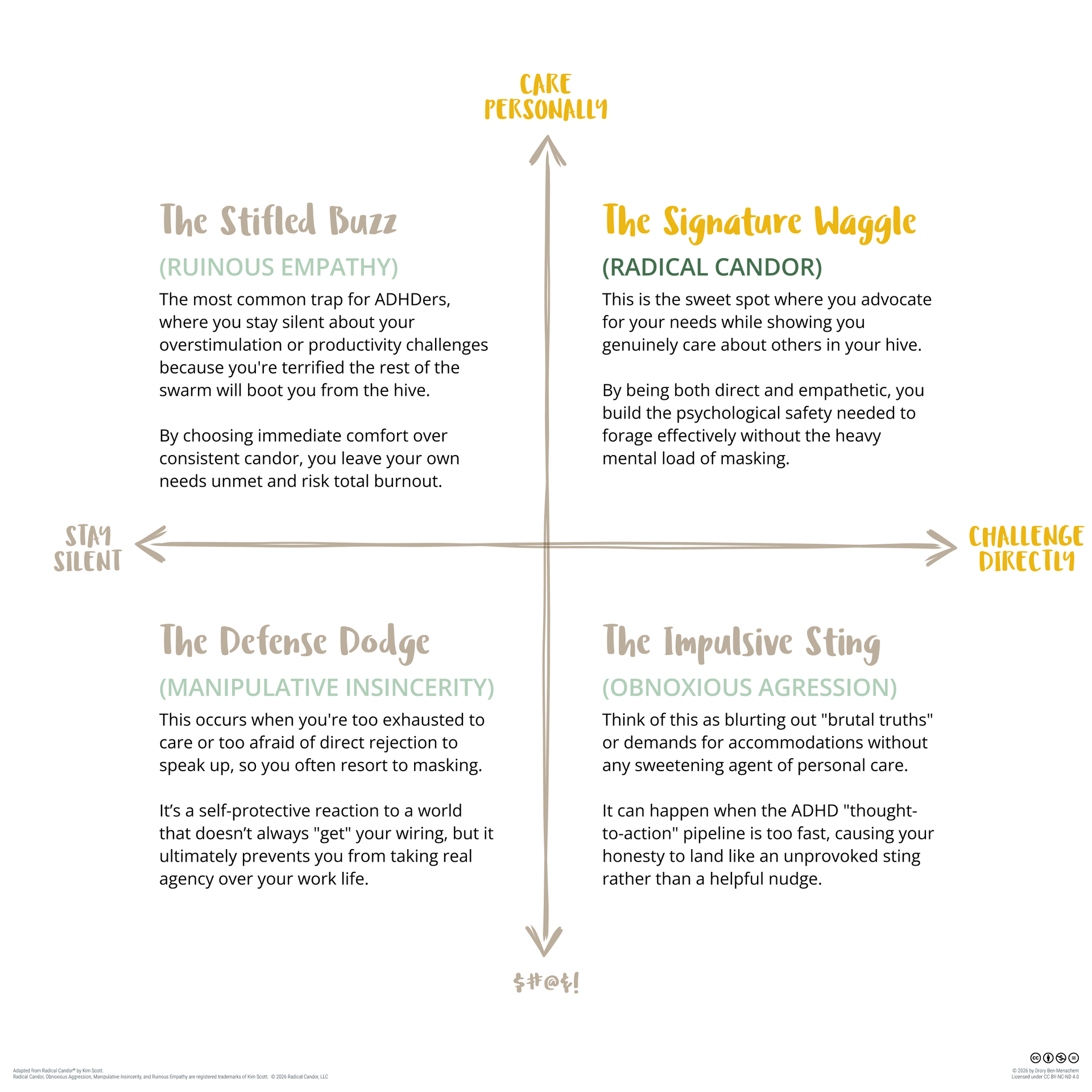
The Radical Candor model identifies four distinct communication states that occur based on the presence or absence of care and challenge. Understanding these quadrants is essential for ADHD humans who frequently experience the extremes of these communication styles due to executive dysfunction and emotional dysregulation.
| Communication Quadrant | Care Personally | Challenge Directly | ADHD Behavioral Intersection |
|---|---|---|---|
| Radical Candor | High | High | Alignment of justice sensitivity with empathetic delivery; creates psychological safety. |
| Obnoxious Aggression | Low | High | Impulsive blurting of "brutal truths" without social context or care for the recipient’s emotional state. |
| Ruinous Empathy | High | Low | People-pleasing behavior driven by Rejection Sensitivity Dysphoria (RSD); withholding needs to avoid conflict. |
| Manipulative Insincerity | Low | Low | Passive-aggressive behavior resulting from chronic masking or fear of direct rejection. |
The utility of this table for the ADHD professional lies in its ability to de-personalize communication failures. Instead of viewing a social misstep as a personality flaw, the individual can instead identify which quadrant they fell into and use specific Radical Candor tools to move toward the upper-right quadrant in future communication scenarios.
Neurobiological Hurdles and the Framework’s Remediation
ADHD is characterized by impairments in executive functioning, which includes planning, prioritizing, impulse control, and emotional regulation. These impairments create unique barriers to personal agency—the capacity to act independently and make choices—and advocacy—the act of speaking up for one's needs.
Rejection Sensitivity Dysphoria (RSD) and the Ruinous Empathy Trap
One of the most debilitating aspects of the ADHD experience is RSD, an intense emotional pain triggered by the perception of being rejected or criticized. RSD often drives ADHD individuals into the "Ruinous Empathy" quadrant, where they care so much about avoiding the pain of a negative reaction that they fail to challenge others or advocate for themselves. Scott’s framework addresses this by redefining "niceness." Radical Candor posits that withholding the truth to spare someone's short-term feelings is actually a "disservice" that leads to long-term failure. For an ADHD person, this reframing is a vital cognitive shift: advocacy is no longer a selfish act of conflict but a necessary act of kindness that prevents "Ruinous Empathy" from sabotaging their career and relationships.
Executive Dysfunction and the Challenges of Immediacy
Executive Dysfunction manifests as "time blindness," making it difficult to gauge when to deliver feedback or set boundaries. Radical Candor emphasizes that feedback should be "Immediate" to keep it light and prevent it from building up into an overwhelming "pile-on". For the ADHD brain, which thrives on dopamine and immediate feedback loops, this principle is highly compatible. However, the impulsivity associated with ADHD can lead to "Obnoxious Aggression" if the "Immediate" feedback is delivered without the "Care Personally" component.
To mitigate this, the framework suggests "stating your intentions" before giving direct feedback. This deliberate pause allows the ADHD individual to re-engage the prefrontal cortex, ensuring that their request for an accommodation or their critique of a process is framed as a "gift" intended to help, rather than a punishment.
Strategic Self-Advocacy through the CORN/CORE Models
Self-advocacy for ADHD individuals often centers on requesting accommodations, such as quiet workspaces, asynchronous communication, or flexible deadlines.[16, 17, 23] Radical Candor provides specific verbal structures, such as the CORN or CORE models, to facilitate these requests with clarity and professional gravity.
The Architecture of a Radical Request
The CORN model (Context, Observation, Result, Next Steps) allows an individual to present their needs through an objective, data-driven narrative.
| Step | Context | Observation | Result | Next Steps |
|---|---|---|---|---|
| Purpose in Advocacy | Ground the request in a specific time or place. | State the specific sensory or cognitive barrier. | Explain the impact on productivity or results. | Propose a concrete, radically candid solution. |
| ADHD Specific Example | "As you know, a lot of information is rapidly covered in our weekly team sprint planning..." | "...and it's often hard for me to juggle my focus between listening to the conversation and taking notes." | "This results in me needing to ask for clarifications mid-week, which delays my deliverables." | "To remedy this, I'd like to record these meetings and use the transcript to capture my tasks." |
By utilizing the CORE/CORN structure, the ADHD advocate avoids the "Manipulative Insincerity" of pretending they don't need help, and the "Obnoxious Aggression" of blaming the manager for their own struggle. Instead, they demonstrate "Radical Candor" by showing they "Care Personally" about the team's results while "Challenging Directly" the current, ineffective communication method.
HHIIPP: The Standards of Empathetic Advocacy
The HHIIPP framework (Humble, Helpful, Immediate, In-person, Private, Not about personality) serves as a checklist for ensuring that advocacy remains professional and effective.
- Humble: The advocate acknowledges their perspective might be incomplete, asking "What do you think?" after presenting a need.
- Helpful: The request is framed as a solution to improve the workplace, not a personal demand.
- Immediate: Issues are addressed as they arise, preventing the buildup of resentment or "neurodivergent paralysis".
- In-person: High-bandwidth communication (video or face-to-face) is used to navigate the nuances of the conversation, which is critical for those who might struggle with tone in text-based formats.
- Private: Advocacy for personal needs is conducted in a one-on-one setting to avoid triggering defensiveness or embarrassment.
- (not about) Personality: The discussion focuses on behaviors and environmental factors (e.g., "I need a quiet space") rather than fixed identity traits (e.g., "I'm just a distracted person").
Upward Feedback: Advocating to Authority with ADHD
Navigating power dynamics is perhaps the most challenging aspect of professional agency for ADHD individuals. The fear of authority, compounded by a history of negative feedback, can make "Challenging Directly" feel impossibly risky. Radical Candor addresses this by establishing that feedback is a two-way street and that leaders have a responsibility to "solicit feedback" before they "dish it out".
Managing Risk in Advocacy
When giving "upward feedback" or advocating to a boss, the ADHD individual must manage professional risk while remaining candid.
- Assume Good Intent: Approaching a manager with the assumption that they want the employee to succeed helps mitigate the "limbic system hijack" associated with RSD.
- Ask for Permission: Using a "pre-flight" question like "Is it okay if we talk about my workflow needs?" gives the manager agency and makes them more receptive to the subsequent request.
- Start Small: Advocacy is a skill built over time. Starting with low-stakes requests—such as asking for a meeting to be moved by 30 minutes to allow for "transition time"—builds the confidence needed for larger requests regarding accommodations or salary.
The "Orange Box" and Other Tools for Radical Cultures
In workplaces that have successfully adopted Radical Candor, tools like Michael Dearing's "Orange Box" or suggestion boxes can be invaluable for ADHD individuals who find it difficult to speak up in the moment due to overstimulation or auditory processing issues. These asynchronous feedback channels allow the ADHD person to process their thoughts and deliver them in a structured, radically candid way without the pressure of an immediate social performance.
Boundary Setting and the "Energy Shield"
For those with ADHD, personal agency is often a matter of energy management. Boundaries are the "personal energy shield" that protects an individual from burnout, overstimulation, and the depletion of executive functions. Radical Candor supports boundary setting by establishing that "No" is a complete sentence and that being honest about one's capacity is an act of "Caring Personally" for the team’s integrity.
Integrating DEAR MAN with Radical Candor Principles
The DEAR MAN framework from Dialectical Behavior Therapy (DBT) is often used in ADHD coaching to help individuals set boundaries. When layered with Radical Candor, it becomes a powerful tool for self-advocacy in social and professional settings.
| Radical Candor Pillar | DEAR MAN Action | ADHD Boundary Application |
|---|---|---|
| Challenge Directly | Describe facts | "I have been working through my lunch break for two weeks." |
| Care Personally | Express feelings | "I am feeling overstimulated and my focus is dropping." |
| Specific Feedback | Assert needs | "I need to take a 30-minute silent break to recharge my focus." |
| Helpful/Humble | Reinforce positivity | "This will allow me to be more present in our afternoon strategy session." |
| Private/Humble | Mindful & Appear confident | Avoid the ADHD trap of over-explaining or apologizing for the boundary. |
| Humble | Negotiate | "If this time doesn't work, let's find another 30-minute block." |
By using this structured approach, the ADHD individual avoids the "Ruinous Empathy" of saying yes to everything until they crash, and the "Obnoxious Aggression" of a sudden, angry outburst when their limits are finally reached.
Authenticity, Unmasking, and the "Just Work" Context
A critical component of personal agency is the ability to be one's authentic self. For many with ADHD, "professionalism" has historically been a code for "masking" neurodivergent traits. Radical Candor, however, encourages bringing one's "whole self" to work and viewing humanity as a competitive advantage rather than a liability.
Radical Candor as a Form of Unmasking
When an ADHD individual practices Radical Candor, they are essentially engaging in a controlled form of "unmasking." By "Caring Personally" enough to admit when they are having a "bad brain day" or struggling with a specific executive task, they create a safe space for others to do the same. This transparency reduces the cognitive load of masking, freeing up dopamine and mental energy for actual work tasks.
Addressing Workplace Injustice and Bias
In her subsequent work, "Just Work," Kim Scott applies the lens of Radical Candor to workplace injustice, which is highly relevant for ADHD individuals who may face bias, bullying, or incorrect assumptions about their intelligence or work ethic. The ADHD advocate can use "I" statements to call out bias without devolving into conflict. For example, if a manager assumes an ADHD employee's lack of eye contact is a sign of disrespect, the radically candid response is: "I've noticed you mention my eye contact (Observation). I find that I can listen much more effectively when I look at my notes rather than your face (I Statement/Result). It's how my brain processes information (Context/Helpful)".
Advocacy as a Lifelong Skillset
Advocacy is not a one-time event but a skillset that ADHD individuals build throughout their lives. Radical Candor provides the "shared vocabulary" and "order of operations" necessary to practice this skill daily in low-stakes environments before applying it to high-stakes career decisions.
The Role of Positive Feedback in ADHD Development
While much of the focus on Radical Candor is on criticism, "Specific and Sincere Praise" is equally important for the ADHD brain. ADHD individuals are often "feedback-starved" for positive reinforcement, having grown up in environments that focused primarily on their deficits. Specific praise — "I noticed how you broke down that complex project into five clear milestones (Observation), which kept the team on track and reduced our stress (Result)" — provides the necessary context for ADHD individuals to understand their own strengths. This, in turn, boosts the self-esteem required for effective self-advocacy.
Radical Candor in Education and Personal Relationships
The framework's utility extends beyond the office. For neurodivergent children and students, "explicitly teaching" self-advocacy scripts based on Radical Candor principles can prevent the development of chronic masking and low self-worth. By modeling their own self-advocacy — sharing when they are overwhelmed and how they are addressing it — parents and educators can provide a blueprint for neuro-eclectic success.
Conclusion: Clarity as the Path to Agency
For the ADHD human, personal agency is frequently obscured by the "fog" of executive dysfunction, the "noise" of sensory overstimulation, and the "pain" of RSD. Kim Scott’s Radical Candor framework acts as a high-powered lens that cuts through this fog. By establishing that "clarity is kindness," the framework gives ADHD individuals the moral and professional permission to advocate for the environments they need to thrive.
The transition from "Ruinous Empathy" — suffering in silence to be "nice" — to "Radical Candor" —speaking the truth with empathy — is the fundamental shift required for neurodivergent agency. When an ADHD individual uses the CORN/CORE models to request accommodations, the HHIIPP criteria to deliver feedback, and "Just Work" principles to challenge bias, they are no longer a "deviant" struggling to fit a norm. Instead, they become an agentic contributor who uses their unique neurobiology to drive results through honesty, humanity, and a relentless commitment to collective growth.The radical nature of the candor lies not in the bluntness of the truth, but in the courage to be seen, heard, and accommodated in a world that is only beginning to understand the value of the neuro-eclectic mind.
SOURCES
- Wired Differently, Working Brilliantly: Understanding and Supporting ADHD & AuDHD Employees
- Experiences of camouflaging by AFAB University Students with ADHD in South Africa
- Radical Candor: The Manager's Handbook
- Radical Candor Approach: Kim Scott's Feedback Framework
- Radical Candor Framework: ModelThinkers
- Embracing Radical Candor: A Leadership Approach to Build Trust
- Radical Candor and Honesty: Navigating Communication with ADHD
- ADHD & Difficulty With Boundary Setting
- Understanding Rejection Sensitivity Dysphoria (RSD) and ADHD
- Building your Inclusion Toolbox: Radical Candor
- How to set boundaries when you have ADHD
- Self-Advocacy Can Improve Your Life
- 3 Ways to Teach Neurodivergent Kids Self-Advocacy
- 5 Lessons from Radical Candor on effective communication among diverse teams
- ADHD and communicating boundaries: Why saying no feels hard (and how to start)
- Radical Candor's “Give Feedback” Playbook
- How To Request Accommodations and Advocate for Yourself in College
- How to Practice Radical Candor With Your Boss
- Self-Advocacy in the Workplace: Requesting Job Accommodations
- Self-Advocacy Scripts to Empower Neurodivergent Kids: A Research-Backed Guide for Parents
- Want to Stop Quiet Cracking? Double Down On Radical Candor
- A Qualitative Study of Structural Contributors to Disability
- YCNCourse Pack: Microaggressions
- Temple Grandin Talks About Why Clear Feedback for Neurodivergent Individuals Matters


